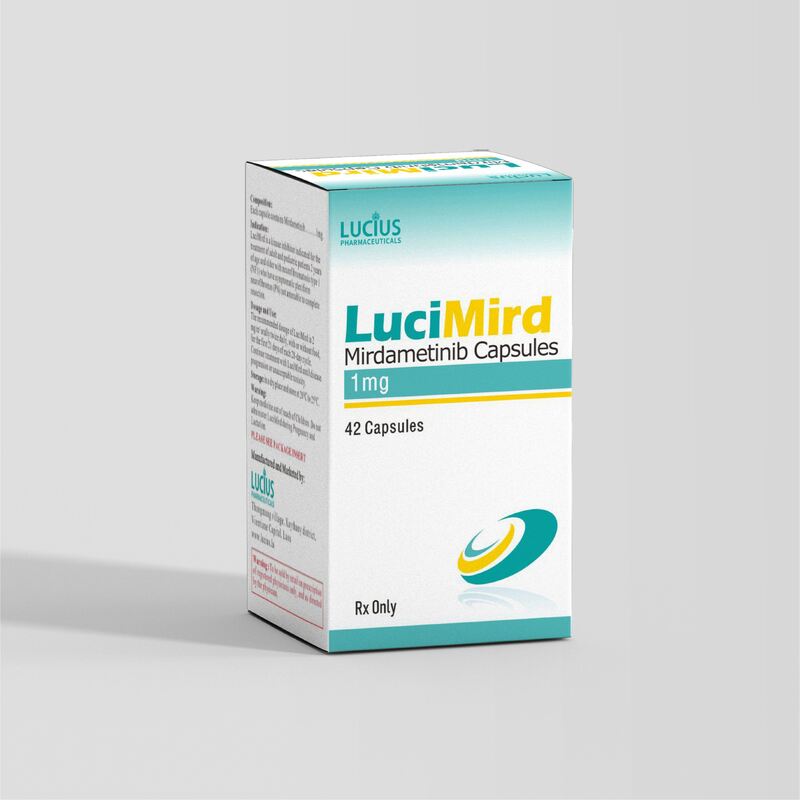
Manufacturer: Lao Lucius Health Products Co., Ltd.
Chinese name: Mirdametinib Capsules
English name: Mirdametinib Capsules
Registration serial number: 03-LM-01455-26
Indications
LuciMird is a kinase-modulating agent indicated for adults and pediatric patients 2 years of age and older with neurofibromatosis type 1 (NF1) who have symptomatic plexiform neurofibromas that cannot be completely resected by surgery.
Administration
The recommended dose of LuciMird is 2 mg/m² orally twice daily for 21 consecutive days (the first 21 days of each 28-day cycle), taken with or without food. Continue LuciMird until disease progression or unacceptable toxicity occurs.
Product Specification
Each tablet contains 1 mg; 42 tablets per box.
Limitation of Use
None
Important Notes and Monitoring Points
Risk of ocular disorders: A comprehensive eye examination should be performed before starting LuciMird, at regular intervals during treatment, and whenever new or worsening visual changes or blurred vision occur. Depending on the severity of symptoms, decide whether to continue, interrupt, reduce the dose, or permanently discontinue LuciMird.
Decreased left ventricular pumping function: An echocardiogram should be performed before taking LuciMird to assess ejection fraction, then every 3 months during the first year of treatment, and thereafter as clinically indicated. Depending on the severity of symptoms, interrupt dosing, reduce the dose, or permanently discontinue LuciMird.
Abnormal skin reactions: Once early skin symptoms, including skin redness and rash, appear, soothing care should be initiated immediately. Depending on severity, interrupt dosing, reduce the dose, or permanently discontinue LuciMird.
Risk to fetal development: May cause harm to the unborn baby. Women of childbearing potential should be informed of the potential risk to the baby, and reliable contraception should be recommended.
Adverse Reactions Following Administration
Adult patients
Most common adverse reactions (incidence >25%): rash, diarrhea, nausea, musculoskeletal pain, vomiting, and fatigue.
Most common grade 3 or 4 laboratory abnormalities (incidence >2%): increased creatine phosphokinase.
Pediatric patients
Most common adverse reactions (incidence >25%): rash, diarrhea, musculoskeletal pain, abdominal pain, vomiting, headache, paronychia, decreased left ventricular pumping function, and nausea.
Most common grade 3 or 4 laboratory abnormalities (incidence >2%): decreased neutrophil count and increased creatine phosphokinase.
Instructions for Special Populations
Lactation: Breastfeeding is not recommended.
Effects on fertility: May affect female reproductive ability.
Storage Rules
Store at 20°C to 25°C (68°F to 77°F); temperature fluctuations between 15°C and 30°C (59°F to 86°F) are acceptable for short-distance transport. Keep away from moisture.